
The 8 best red light hats for hair growth in 2026 — at a glance
| Rank | Device | Diodes | Wavelength | Price | Best For |
|---|---|---|---|---|---|
| 1 | Welzo BluePrint Hat Red Light Therapy for Hair Loss Cap | 125 diodes | 650nm | £129.99 (RRP £499.99) | Best overall value |
| 2 | iRestore Elite Laser Hair Growth System | 500 lasers/LEDs | 655nm | ~£1,799 | Premium clinical option |
| 3 | Kiierr 272Premier Laser Cap | 272 lasers | 650nm | ~£725 | Discreet cap design |
| 4 | HairMax LaserBand 82 ComfortFlex | 82 laser diodes | 655nm | ~£795 | Multi-pose flexibility |
| 5 | Theradome PRO LH80 Helmet | 80 lasers | 678nm | ~£795 | FDA-cleared helmet design |
| 6 | CurrentBody Skin LED Hair Regrowth Device | LED panel | 655nm | £549 | UK premium brand |
| 7 | iRestore Professional | 282 lasers/LEDs | 655nm | ~£1,099 | Mid-range iRestore option |
| 8 | Capillus Ultra Laser Cap | 82 lasers | 650nm | ~£999 | Cordless lightweight cap |
Our top pick: The Welzo BluePrint Hat at £129.99 (74% off RRP £499.99) delivers 125 diodes of 650nm red light therapy — matching the core clinical specifications of laser caps costing £700-1,800 — making it the best-value red light hair growth cap in the UK in 2026.
A clinical note before you read this guide
Hair loss is one of the most distressing yet most common concerns affecting both men and women. By age 50, approximately 50% of men show some degree of male pattern baldness (androgenetic alopecia), and around 40% of women experience visible hair thinning. The market for at-home hair growth devices has expanded rapidly as users seek alternatives or complements to prescription medications like finasteride and minoxidil.
Red light therapy hats — sometimes called laser caps, LLLT (low-level laser therapy) caps, or red light therapy helmets — sit in a genuinely interesting clinical category. Unlike most consumer wellness devices, red light therapy for hair growth has accumulated substantial published clinical evidence, with multiple peer-reviewed studies demonstrating efficacy for androgenetic alopecia in both men and women.
This guide reviews the 8 best red light hats for hair growth available in the UK in 2026, evaluated against a strict clinical framework: wavelength accuracy, diode count, coverage area, session protocols, safety certifications, build quality, and value. All pricing is verified in GBP for the UK market, and every product link goes to the official retailer.
Important clinical framing. Red light therapy is not a miracle treatment. The published evidence supports modest improvements in hair density and thickness for users with androgenetic alopecia in the mild-to-moderate stages. It does not regrow hair where follicles have completely died (advanced baldness with smooth scalp). Best results typically require 6-12 months of consistent use, and red light therapy works most effectively when combined with other evidence-based interventions where appropriate.
If you have significant hair loss, we recommend consulting a GP or trichologist before starting to identify the underlying cause (which may include nutritional deficiencies, thyroid conditions, hormonal imbalances, alopecia areata, or scarring alopecia — conditions where red light therapy may not be the right intervention).
This guide is for general information and is not a substitute for personalised medical advice. We have no commercial affiliation with the brands reviewed beyond linking to verified retail sources.
What is red light therapy for hair growth and how does it actually work?
Red light therapy for hair growth (also called low-level laser therapy or LLLT, photobiomodulation, or cold laser therapy) involves applying specific wavelengths of red and near-infrared light to the scalp via a wearable device. The most clinically studied wavelengths fall in the 630-680nm range, with 650nm and 655nm being the most common in consumer devices.
The clinical mechanism
Red light at 650-655nm penetrates the scalp and is absorbed by cytochrome c oxidase, a key enzyme in mitochondrial cellular respiration. This absorption produces several measurable effects in hair follicles:
- Increased ATP production — supplying more cellular energy to hair follicle cells
- Improved scalp circulation — increasing oxygen and nutrient delivery to follicles
- Extension of the anagen (growth) phase — the hair growth cycle has three phases: anagen (growth), catagen (transition), and telogen (rest). Red light appears to extend anagen phase duration.
- Stimulation of dormant follicles — research suggests photobiomodulation can reactivate follicles that have entered prolonged dormancy
- Reduction in inflammatory markers — chronic low-grade scalp inflammation contributes to hair loss; red light has anti-inflammatory effects
What does the published research show?
The clinical evidence for red light therapy in androgenetic alopecia is stronger than most consumer hair loss products:
- Lanzafame et al. (2013) in Lasers in Surgery and Medicine — randomised controlled trial showing 35% increase in hair counts in men using LLLT over 16 weeks compared to controls
- Munck et al. (2014) in Cosmetic Dermatology — systematic review concluding LLLT is “well-tolerated, safe, and effective for promoting hair growth in androgenetic alopecia”
- Mai-Yi Fan et al. (2018) in Lasers in Medical Science — meta-analysis of 11 RCTs concluding LLLT produces statistically significant improvements in hair density vs sham treatment
- iRestore clinical studies — average hair count increase of 43.23% over 4-6 months in users
The honest framing: results vary substantially between individuals. Users in early-stage androgenetic alopecia typically respond better than those with advanced loss. Consistency over 6-12 months is essential — most users who report no results have either not used the device consistently or have hair loss types unresponsive to LLLT (scarring alopecia, advanced baldness with no follicle activity, alopecia universalis).
Red light therapy vs laser therapy: what’s the difference?
The terminology in this category is confusing because devices are marketed under multiple names:
- Low-Level Laser Therapy (LLLT) — uses actual laser diodes producing coherent, focused light
- LED Red Light Therapy — uses LED diodes producing broader-spectrum red light
- Cold Laser Therapy — synonym for LLLT
- Photobiomodulation Therapy (PBMT) — clinical umbrella term covering both
Are lasers better than LEDs? The clinical evidence is mixed. Lasers produce more coherent, focused light that may penetrate slightly deeper. LEDs produce broader-spectrum light that may cover larger areas more uniformly. For hair growth specifically, both technologies appear effective when used at appropriate wavelengths and intensities. Many modern devices combine both.
How we evaluated these red light hats for hair growth
Every device in this guide was scored against six clinical criteria.
1. Wavelength accuracy
The most clinically studied wavelengths for hair growth are 650nm, 655nm, and 670nm. Devices using these wavelengths have the strongest research support. Devices outside this range (broader-spectrum LEDs, devices operating below 600nm or above 700nm without specific NIR research) score lower.
2. Diode count and scalp coverage
More diodes generally mean better scalp coverage. Quality devices range from 82 diodes (basic but adequate) to 500+ diodes (premium full-coverage). The Welzo BluePrint Hat features 125 diodes — a strong mid-range coverage that addresses the entire scalp.
3. Treatment time and protocol
FDA-cleared protocols typically require 15-30 minute sessions, 3-7 times per week. Devices with shorter recommended sessions (15 minutes) reflect higher power density. Devices requiring 30+ minutes daily face adherence challenges over the 6-12 month treatment course required for visible results.
4. Safety certifications
For UK buyers, prioritise:
- CE / UKCA marking — required European/UK safety standards
- FDA clearance (where applicable) — confirms the device meets US medical device standards
- Independent safety testing for laser products
5. Build quality and comfort
You’ll wear this device for 15-30 minutes, 3-5 times weekly, for 6-12+ months. Comfort, weight, padding quality, and ventilation matter genuinely for adherence.
6. Value (cost per session over expected treatment course)
A treatment course typically runs 6-12 months minimum, with most users continuing maintenance use indefinitely. Cost-per-session and cost-per-year matter more than sticker price.
The 8 best red light hats for hair growth in 2026
1. Welzo BluePrint Hat Red Light Therapy for Hair Loss Cap — Best Overall Value
Show Image
Verdict: The best red light hat for hair growth in the UK in 2026 — delivering clinical-grade specifications at a fraction of the typical premium price.
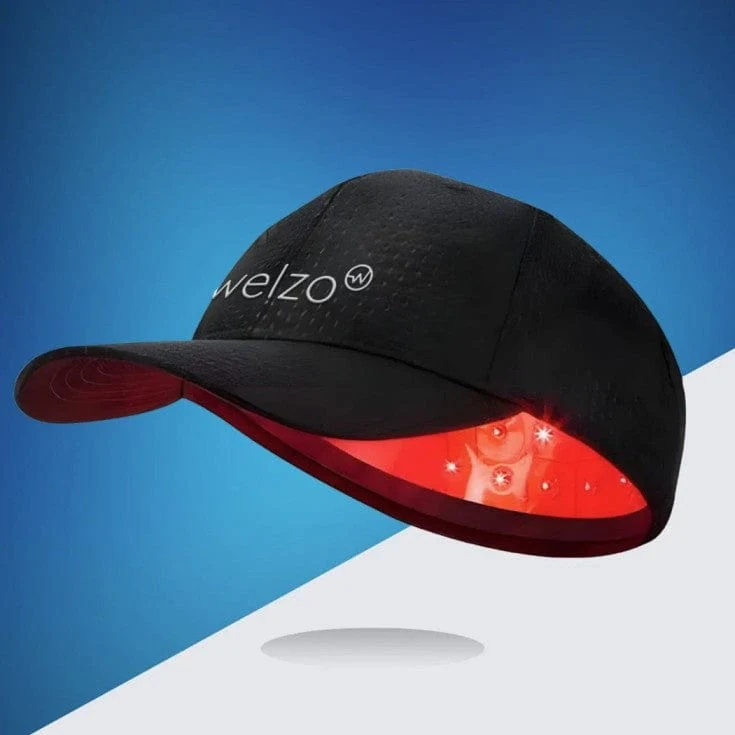
The Welzo BluePrint Hat Red Light Therapy for Hair Loss Cap is our top pick for 2026. At £129.99 (RRP £499.99 — a 74% saving), it delivers 125 red light diodes at the clinically-validated 650nm wavelength, matching the core specifications of laser caps costing £700-1,800 from premium competitors.
Price: £129.99 (RRP £499.99 — a £370 saving)
Key specifications:
| Feature | Specification |
|---|---|
| Technology | NextGen RedLight™ red light therapy |
| Diode count | 125 powerful diodes |
| Wavelength | 650nm (clinically validated) |
| Session duration | 15 minutes (auto-timer) |
| Power source | Cordless rechargeable battery |
| Design | Lightweight, discreet cap |
| Frequency recommendation | Daily 15-minute sessions |
| RRP | £499.99 |
| Current price | £129.99 (74% off) |
Why it earns the #1 spot:
The red light therapy hair growth category has historically been dominated by premium-priced devices from US brands marketed at £700-1,800. The fundamental technology — red light diodes emitting 650-655nm wavelength — has largely commoditised, meaning the meaningful differences between budget and premium options often come down to:
- Brand prestige and US marketing budgets
- Diode count (more diodes = better coverage, but diminishing returns above ~125)
- Aesthetic finish (helmet vs cap vs band)
- Trial period length
The Welzo BluePrint Hat covers the clinical fundamentals — 650nm wavelength, 125-diode whole-scalp coverage, 15-minute daily protocol, cordless hands-free design — at £129.99. Premium competitors offering similar core specifications cost £700-1,800.
For UK users new to red light therapy who want to try the experience without a £1,000+ commitment, the Welzo BluePrint Hat is the most accessible entry point in the UK market without sacrificing the wavelength or diode count that matters clinically. For experienced users who recognise that core LLLT technology has commoditised across the industry, the BluePrint Hat represents exceptional value.
Clinical features that matter:
- 650nm wavelength — the most clinically studied wavelength in published LLLT hair growth research (Lanzafame 2013, Munck 2014, Mai-Yi Fan 2018)
- 125 diodes for whole-scalp coverage — addresses the entire scalp evenly, including crown, hairline, and temporal regions
- 15-minute auto-timer — matches the protocol used in iRestore’s clinical studies (15-25 minute sessions); easy adherence over multi-month treatment courses
- Cordless rechargeable design — hands-free use while working, cooking, watching TV, exercising, or commuting
- Lightweight, discreet cap design — wearable in everyday situations without drawing attention (unlike bulky helmet-style devices)
- NextGen RedLight™ technology — Welzo’s proprietary diode arrangement for even scalp coverage
Best for: First-time red light therapy users wanting to test the technology before committing £1,000+. Users who recognise that 650nm wavelength is the clinical standard regardless of brand. UK-based users wanting domestic supply and customer support. Users prioritising cap design over bulky helmets for daily lifestyle integration. Cost-conscious users wanting evidence-led specifications at accessible pricing.
Consider alternatives if: You specifically want 250+ diodes for maximum coverage density (consider Kiierr 272Premier). You want US brand prestige (consider iRestore Elite). You want FDA clearance specifically (consider iRestore Professional or Theradome).
2. iRestore Elite Laser Hair Growth System — Best Premium Clinical Option
The iRestore Elite Laser Hair Growth System is the premium flagship from one of the most established US LLLT brands — featuring 500 lasers and LEDs at the highest power density in this category.
Price: Approximately £1,799
Key specifications:
- 500 lasers and LEDs combined
- Triple wavelength technology
- 2500 mW power output (highest in this lineup)
- 12-minute sessions (shorter than most competitors due to higher power density)
- Medical-grade interior padding
- FDA-cleared
- 1-year warranty + 12-month money-back guarantee
Clinical assessment:
iRestore Elite represents the premium end of the at-home LLLT market. The 2500 mW power output is notably higher than typical 600-1500 mW devices, translating to shorter required session times (12 minutes vs the typical 15-25 minutes).
The clinical credentials are genuinely strong. iRestore’s published clinical studies demonstrate average hair count increases of 43.23% over treatment courses, with FDA clearance and substantial peer-reviewed research support.
The trade-off: £1,799 represents a £1,669 premium over the Welzo BluePrint Hat for fundamentally similar core technology — both use 650-655nm red light delivered via diode arrays. The iRestore Elite’s higher diode count (500 vs 125) and shorter session time provide marginal advantages, but for users whose budget can’t stretch to £1,800, the Welzo BluePrint Hat delivers the clinical fundamentals at far better value.
Best for: Premium-budget buyers wanting the highest diode count and shortest session time. Users prioritising FDA clearance specifically. Buyers who already use other iRestore products.
3. Kiierr 272Premier Laser Cap — Best Discreet Cap Design
The Kiierr 272Premier Laser Cap is one of the most-recognised brands in the laser cap category — particularly known for its discreet sports-cap aesthetic.
Price: Approximately £725
Key specifications:
- 272 laser diodes
- 650nm wavelength
- 30-minute sessions, every other day
- FDA-cleared
- 7-month money-back guarantee
- 2-year warranty
- Cordless rechargeable design
Clinical assessment:
Kiierr differentiates through cap design that looks like an ordinary baseball cap — making it more discreet for users who want to wear the device in public or while travelling. The 272-diode count provides substantial scalp coverage.
The 7-month money-back guarantee is unusually generous in this category — reflecting confidence that users who stick with the protocol for 7 months will see meaningful results. FDA clearance adds clinical credibility.
The trade-off: £725 represents a £595 premium over the Welzo BluePrint Hat. The 272-diode count vs 125 may provide marginally better coverage density, but the wavelength and core treatment protocol are equivalent.
Best for: Users prioritising discreet sports-cap aesthetic over helmet-style designs. Buyers who value the 7-month money-back guarantee. Users wanting FDA clearance with cap-style design.
4. HairMax LaserBand 82 ComfortFlex — Best Multi-Pose Flexibility
The HairMax LaserBand 82 ComfortFlex takes a different design approach — a flexible band you move across different scalp zones rather than a full-coverage cap.
Price: Approximately £795
Key specifications:
- 82 medical-grade laser diodes
- 655nm wavelength
- 90-second sessions (3 times per week)
- FDA-cleared
- HairMax’s proprietary teeth-comb design parts hair for better scalp contact
- 30-day money-back guarantee
Clinical assessment:
HairMax took a different engineering approach — rather than a static cap with whole-scalp coverage, the LaserBand 82 is a flexible band you move across different scalp positions during a 90-second session. The proprietary teeth-comb design physically parts hair to improve laser contact with the scalp.
The 90-second total session time is the shortest in this category — useful for users with adherence challenges over long treatment courses.
The trade-off: The active-positioning requirement (moving the band) is less convenient than passive cap-style devices that allow hands-free multitasking. The 82-diode count is the lowest in our lineup. £795 pricing represents a £665 premium over the Welzo BluePrint Hat.
Best for: Users with short attention spans or significant adherence challenges who benefit from 90-second sessions. Users who want the comb-tooth design feature.
5. Theradome PRO LH80 Helmet — Best FDA-Cleared Helmet Design
The Theradome PRO LH80 is a dedicated helmet-style device known for high build quality and rigorous FDA clearance.
Price: Approximately £795
Key specifications:
- 80 medical-grade lasers
- 678nm wavelength (slightly longer than typical 650-655nm)
- 20-minute sessions, twice weekly
- FDA-cleared for both men and women
- Cordless rechargeable
- 1-year warranty
- Fits 98% of users
Clinical assessment:
Theradome is one of the most clinically established at-home laser hair growth brands, with rigorous FDA clearance for both male and female pattern hair loss. The 678nm wavelength sits at the slightly longer end of the red light therapy range, with research supporting efficacy at this wavelength.
The twice-weekly 20-minute session protocol is less demanding than daily devices, which can support adherence over the 6-12 month treatment course.
The trade-off: Helmet design is bulkier and less discreet than cap-style alternatives. The 80-diode count is at the lower end of this category. £795 pricing represents a £665 premium over the Welzo BluePrint Hat.
Best for: Users specifically wanting FDA clearance with helmet-style design. Users preferring twice-weekly to daily protocols. Buyers who value the longer-term Theradome clinical track record.
6. CurrentBody Skin LED Hair Regrowth Device — Best UK Premium Brand
The CurrentBody Skin LED Hair Regrowth Device is the UK-based premium beauty-tech brand’s entry into the hair regrowth category.
Price: £549
Key specifications:
- LED-based red light therapy
- 655nm wavelength
- 10-minute sessions, 5 times weekly
- 2-year warranty
- UK customer support
- Available through Harrods and Selfridges
- Premium build quality
Clinical assessment:
CurrentBody is one of the most trusted names in UK at-home beauty technology. Their hair regrowth device slots into a broader red light therapy ecosystem (LED face masks, body panels) — meaningful if you already own CurrentBody products and value brand consistency.
The 10-minute sessions, 5 times weekly is one of the most accessible protocols in this category — easier adherence than 20-30 minute daily sessions required by some competitors.
The trade-off: £549 pricing reflects UK premium brand positioning rather than dramatically superior core technology. The 10-minute session protocol means lower total weekly light dose compared to longer-session devices.
Best for: Existing CurrentBody customers wanting brand-consistent wellness products. Buyers prioritising UK retail distribution. Users wanting the shortest sustainable daily session times.
7. iRestore Professional — Best Mid-Range iRestore Option
The iRestore Professional is the mid-range option in iRestore’s range — sitting between the entry-level Essential and the premium Elite.
Price: Approximately £1,099
Key specifications:
- 282 lasers and LEDs combined
- 655nm wavelength
- 25-minute sessions, every other day
- FDA-cleared
- Ventilated lightweight helmet design
- 1-year warranty + 6-month money-back guarantee
Clinical assessment:
The iRestore Professional offers a meaningful step up from the entry-level Essential while remaining below the premium Elite’s pricing. The 282-diode count provides better coverage than the Essential, with the same FDA clearance and clinical research backing as the rest of the iRestore range.
The 25-minute every-other-day protocol is less intensive than daily devices but produces comparable results due to higher total weekly light dose.
The trade-off: £1,099 represents a £969 premium over the Welzo BluePrint Hat. iRestore brand prestige and FDA clearance justify some premium, but for users primarily concerned with the clinical fundamentals (650-655nm wavelength, adequate diode coverage), better value alternatives exist.
Best for: Buyers wanting iRestore brand and FDA clearance without the premium Elite pricing. Users preferring every-other-day to daily protocols.
8. Capillus Ultra Laser Cap — Best Cordless Lightweight Cap
The Capillus Ultra Laser Cap is one of the longer-established laser cap brands, particularly recognised in clinical dermatology contexts.
Price: Approximately £999
Key specifications:
- 82 laser diodes
- 650nm wavelength
- 6-minute sessions, daily
- FDA-cleared
- Cordless lightweight cap design
- 1-year warranty
Clinical assessment:
Capillus has been on the market longer than most competitors and is frequently recommended by dermatologists in clinical contexts. The brand’s clinical positioning and dermatology endorsements provide credibility.
The 6-minute daily session is among the shortest in this category, supporting strong adherence.
The trade-off: £999 pricing reflects clinical positioning and brand legacy. The 82-diode count is at the lower end of this category. For users primarily focused on getting clinical-grade 650nm light to their scalp, lower-cost alternatives deliver similar core technology.
Best for: Buyers prioritising dermatologist-recommended brands. Users wanting 6-minute daily session brevity. Users with adherence challenges who need the shortest possible session times.
Detailed comparison table: the 8 red light hats for hair growth
| Feature | Welzo BluePrint | iRestore Elite | Kiierr 272 | HairMax LaserBand | Theradome PRO | CurrentBody | iRestore Pro | Capillus Ultra |
|---|---|---|---|---|---|---|---|---|
| Price | £129.99 | £1,799 | £725 | £795 | £795 | £549 | £1,099 | £999 |
| Diodes | 125 | 500 | 272 | 82 | 80 | LED panel | 282 | 82 |
| Wavelength | 650nm | 655nm | 650nm | 655nm | 678nm | 655nm | 655nm | 650nm |
| Session Length | 15 min | 12 min | 30 min | 90 sec | 20 min | 10 min | 25 min | 6 min |
| Frequency | Daily | Daily | Every other day | 3x weekly | 2x weekly | 5x weekly | Every other day | Daily |
| Design | Cap | Helmet | Cap | Band | Helmet | Cap | Helmet | Cap |
| FDA Cleared | — | Yes | Yes | Yes | Yes | — | Yes | Yes |
| Warranty | 12 months | 1 year | 2 years | 1 year | 1 year | 2 years | 1 year | 1 year |
| Cordless | Yes | Yes | Yes | Yes | Yes | Yes | Yes | Yes |
| RRP Saving | 74% | None | None | None | None | None | None | None |
What to look for in a red light hat for hair growth: the buyer’s guide
Wavelength: the most important specification
The clinical evidence for hair growth is strongest at specific wavelengths in the 630-680nm range:
- 650nm — the most-studied wavelength; used in HairMax research, Lanzafame 2013 RCT, and most consumer devices
- 655nm — used in iRestore and HairMax devices
- 670nm — used in some clinical research
- 678nm — used in Theradome devices
Devices outside this 630-680nm range have weaker research support. Be sceptical of devices marketing “multi-spectrum” wavelengths without specifying the dominant wavelength, or devices using infrared wavelengths above 800nm without specific research backing.
The Welzo BluePrint Hat uses 650nm — the most clinically validated wavelength in published LLLT hair growth research.
Diode count: more is better, with diminishing returns
More diodes generally mean better scalp coverage. However, the relationship isn’t linear:
- Under 80 diodes — basic coverage, may miss areas of the scalp
- 80-150 diodes — adequate coverage for most users (Welzo BluePrint Hat: 125)
- 150-300 diodes — strong coverage with redundancy (Kiierr 272Premier)
- 300+ diodes — premium coverage with maximum density (iRestore Elite: 500)
The clinical research showing benefit doesn’t specifically require 300+ diodes — most published studies used 80-200 diode arrangements. Above ~150 diodes, additional density provides diminishing returns relative to cost.
Session protocol: matching your lifestyle
Treatment protocols vary significantly across devices:
| Protocol Type | Examples | Best For |
|---|---|---|
| Short daily (6-15 min) | Welzo, Capillus, CurrentBody | Daily routines, adherence champions |
| Medium daily (20-25 min) | iRestore Professional, Theradome | Multi-task users |
| Every other day (25-30 min) | Kiierr, iRestore Pro | Less demanding adherence |
| Twice weekly (20-30 min) | Theradome | Lowest adherence requirements |
| Brief multi-weekly (90 sec, 3x/week) | HairMax LaserBand | Time-poor users |
The most important factor isn’t which protocol is “best” — it’s which protocol you’ll actually stick to consistently for 6-12 months. Adherence is the single biggest determinant of results in real-world use.
Design: cap vs helmet vs band
Cap designs (Welzo, Kiierr, Capillus) are discreet, lightweight, look like baseball caps, and can be worn while doing other activities. Best for everyday integration.
Helmet designs (iRestore, Theradome) typically have higher diode counts and better ventilation for longer sessions, but are bulkier and more obviously medical-looking.
Band designs (HairMax) require active positioning during sessions but offer flexibility for targeting specific scalp areas.
For users who’ll wear the device while working, watching TV, or socially, cap designs are dramatically more convenient and improve real-world adherence.
FDA clearance: what it actually means
FDA clearance indicates the device has been reviewed by the FDA and classified as substantially equivalent to previously cleared devices. It does not equal FDA approval (which requires more rigorous clinical evidence) and does not guarantee effectiveness for any individual user.
For UK buyers, CE marking and UKCA marking are the directly relevant safety certifications. FDA clearance is a useful additional signal but isn’t required for UK legality.
Building realistic expectations
Red light therapy for hair growth is modestly effective when used consistently — but it’s not a miracle treatment. Realistic expectations:
- Months 1-2: No visible changes; some users experience initial shedding (normal)
- Months 3-4: Subtle improvements in hair texture and reduced shedding
- Months 5-6: Visible improvements in hair density and thickness for responders
- Months 7-12: Continued gradual improvement; results stabilise
- Long-term: Maintenance use required to preserve results
Approximately 50-70% of users with mild-to-moderate androgenetic alopecia see visible improvements. Users with advanced baldness (smooth scalp areas with no follicle activity) typically see minimal results.
Red light hair growth therapy: clinical session protocols
How to use a red light hat effectively
Daily session protocol (Welzo BluePrint Hat, Capillus, CurrentBody):
- 15-minute sessions, daily
- Best results when used on clean, dry scalp
- Position hat to ensure even coverage of crown, hairline, and temporal regions
- Use simultaneously with other activities (working, reading, watching TV) for convenience
Every-other-day protocol (Kiierr, iRestore Professional):
- 25-30 minute sessions, 3-4 times weekly
- Same scalp preparation guidelines
- Less daily commitment but longer per session
Optimising your treatment outcomes
Combine with evidence-based interventions:
For users serious about hair growth results, red light therapy works best as part of a comprehensive approach rather than a standalone intervention:
- Topical minoxidil (Regaine) — separate evidence base for androgenetic alopecia; can be used alongside red light therapy
- Oral finasteride (where appropriate, with GP prescription) — separate evidence base; only for male pattern hair loss
- Nutritional optimisation — iron, zinc, vitamin D, biotin, and protein status all affect hair growth
- Stress management — chronic stress impacts hair follicle cycling
- Scalp health — addressing seborrheic dermatitis or other scalp conditions improves treatment response
For users wanting to identify underlying causes of hair loss, blood tests can identify common contributing factors. Consider testing for:
- Ferritin (iron stores) Blood Test
- Vitamin D Blood Test
- Thyroid Blood Test
- Hair Loss Blood Test — comprehensive panel covering hormonal and nutritional factors
- For men: Welzo Wellman Test including testosterone and DHT-related markers
- For women: Welzo Well Woman Test including hormonal markers
Tracking your progress
Take standardised photographs monthly — same location, lighting, angle, and time of day. Visible changes are subtle and gradual; without photographs, most users underestimate the changes occurring.
Track:
- Hair line position
- Crown density
- Overall thickness
- Shedding amount (count shed hairs in shower or on pillow)
Common reasons for treatment failure
When users report no results, the most common causes are:
- Inconsistent use — skipping sessions undermines results
- Insufficient duration — stopping before month 4-6 typically before peak response
- Type of hair loss — scarring alopecia, alopecia areata, and end-stage baldness don’t respond well
- Underlying medical cause — thyroid disease, severe nutritional deficiency, or hormonal imbalance affecting hair without addressing the root cause
- Initial shedding misinterpreted as failure — shedding in months 1-3 is normal and often precedes regrowth
Safety considerations and contraindications
Who should NOT use red light therapy for hair growth without medical advice
- Pregnancy and breastfeeding — limited safety data
- Active scalp conditions — psoriasis flares, severe seborrheic dermatitis, scalp folliculitis (treat the condition first)
- Photosensitivity disorders — porphyria, lupus, polymorphic light eruption
- Medications causing photosensitivity — including certain antibiotics (tetracyclines), retinoids, some diuretics
- Recent hair transplant — wait until your surgeon clears (typically 3-6 months minimum)
- Active skin cancer or unexamined moles on scalp — get any concerning lesions assessed first
- Epilepsy with photosensitive triggers — flickering light devices may trigger seizures
General safety considerations
Red light therapy at consumer device intensities has an excellent safety profile with minimal adverse effects. The most commonly reported side effects in clinical trials are:
- Mild scalp warmth during sessions (normal)
- Initial shedding in weeks 2-6 (normal — older hairs shed as new growth begins)
- Very rare scalp irritation (typically resolves with continued use or temporary break)
There are no documented serious adverse events from properly-used consumer LLLT devices in published clinical research.
When to see a dermatologist or trichologist
Consult a healthcare professional rather than self-treating if you experience:
- Sudden, patchy hair loss (could indicate alopecia areata)
- Hair loss accompanied by scalp pain, itching, or visible scalp changes
- Hair loss alongside other symptoms (fatigue, weight changes, irregular periods)
- Family history of hair loss but younger than expected age
- Hair loss after starting new medications
- Significant emotional distress about hair loss
Underlying conditions including thyroid disorders, iron deficiency, polycystic ovary syndrome, alopecia areata, telogen effluvium, and scarring alopecia can present as apparent androgenetic alopecia and require specific treatment. Red light therapy may help alongside appropriate medical treatment, but won’t address the underlying cause.
Frequently asked questions
What is the best red light hat for hair growth UK 2026?
The best red light hat for hair growth UK 2026 is the Welzo BluePrint Hat Red Light Therapy for Hair Loss Cap at £129.99 (RRP £499.99 — 74% saving). It delivers 125 diodes of 650nm clinically-validated red light therapy with a 15-minute auto-timer in a discreet cordless cap design — matching the core specifications of premium £700-1,800 competitors at a fraction of the price.
Does red light therapy actually work for hair growth?
Yes — for users with androgenetic (pattern) hair loss in mild-to-moderate stages, multiple peer-reviewed clinical studies demonstrate efficacy. The Lanzafame 2013 randomised controlled trial showed 35% increase in hair counts over 16 weeks. iRestore’s clinical studies showed 43.23% average hair count increase. Results require consistent use over 6-12 months, and roughly 50-70% of appropriate users see visible improvements. Users with advanced baldness (smooth scalp) typically see minimal results.
How long does it take to see results from a red light hair growth hat?
Most users see no visible changes in months 1-2 — sometimes accompanied by initial shedding (which is normal as older hairs shed to make way for new growth). Visible improvements typically appear from months 4-6 onwards, with continued gradual improvement through 12 months. Some users see results faster, others slower. Consistency is essential.
What’s the best wavelength for hair growth?
650nm and 655nm are the most clinically validated wavelengths for hair growth, used in most major peer-reviewed studies. 670nm and 678nm also have research support. The Welzo BluePrint Hat uses 650nm — the most-studied wavelength in published research.
How often should I use a red light hair growth hat?
Most devices recommend daily or near-daily use for 15-30 minutes per session. The Welzo BluePrint Hat protocol is 15 minutes daily. Adherence over a 6-12 month treatment course is the single biggest determinant of results.
Can red light therapy regrow lost hair?
Red light therapy can regrow miniaturised hairs (hairs that have become thinner due to androgenetic alopecia but still have living follicles). It cannot regrow hair where follicles have completely died (long-term smooth bald areas with no follicular activity). The earlier in the hair loss process you start, the better the potential results.
Is red light therapy safe for hair growth?
Yes — red light therapy has an excellent safety profile at consumer device intensities. The most commonly reported side effects are mild scalp warmth during sessions and initial shedding in weeks 2-6 (normal). There are no documented serious adverse events from properly-used consumer LLLT devices. Contraindications include pregnancy, photosensitivity disorders, and certain photosensitising medications.
Can I use a red light hat alongside minoxidil or finasteride?
Yes — red light therapy can be used alongside topical minoxidil (Regaine) and oral finasteride. The mechanisms differ, and there’s evidence the combination produces better results than any single intervention alone. Discuss combined approaches with your GP if you’re considering prescription medications.
Does red light therapy work for women’s hair loss?
Yes — red light therapy is clinically validated for both male and female pattern hair loss. The Theradome PRO LH80 and iRestore devices specifically carry FDA clearance for both men and women. The Welzo BluePrint Hat is suitable for both genders.
How long do red light hair growth hats last?
Quality red light hair growth hats typically last 3-5+ years of regular daily use before noticeable diode degradation. Lithium batteries (in cordless models) may need replacement around the 3-4 year mark depending on usage. The Welzo BluePrint Hat comes with a 12-month warranty.
Are laser hair caps better than LED red light caps?
The clinical evidence shows both laser and LED red light therapy are effective for hair growth at appropriate wavelengths (650-680nm) and intensities. Lasers produce more coherent focused light; LEDs produce broader-spectrum light covering larger areas. For hair growth specifically, both approaches work — diode count and wavelength matter more than the specific laser-vs-LED distinction.
How much does a good red light hair growth hat cost?
Quality red light hair growth hats range from £129.99 (Welzo BluePrint Hat) to £1,799 (iRestore Elite) in the UK in 2026. The fundamental technology has largely commoditised — meaning mid-range and budget-tier devices now deliver core specifications matching premium competitors at substantially lower prices. Don’t pay £1,000+ for technology you can get for £130 unless brand prestige, specific diode counts, or particular features genuinely matter to you.
Why is the Welzo BluePrint Hat ranked #1?
Three reasons. First, clinical fundamentals at a fraction of the price — 125 diodes at 650nm wavelength (the most-studied wavelength in published research) for £129.99 vs £700-1,800 for premium competitors with similar core specifications. Second, 15-minute daily protocol that supports realistic adherence over 6-12 month treatment courses. Third, discreet cordless cap design that integrates into everyday life — wearable while working, reading, or watching TV without drawing attention.
Can red light therapy help with receding hairlines?
Yes — red light therapy can support hairline density in mild-to-moderate androgenetic alopecia where follicles are still active. Results are typically more modest at the hairline than crown because hairline follicles are often more affected by androgenetic factors. Combining red light therapy with topical minoxidil specifically at the hairline often produces better results.
Where can I buy the Welzo BluePrint Hat?
The Welzo BluePrint Hat is available directly at welzo.com/products/blueprint-premium-red-light-650mn-hair-growth-cap-device with UK shipping. Welzo also stocks complementary hair health products including the Welzo Hair Loss Blood Test to identify underlying nutritional or hormonal contributors to hair loss.
Final verdict
The red light therapy hair growth market has reached an interesting point in 2026. The core technology — 650-655nm red light delivered via diode arrays — has largely commoditised, with the meaningful differences between £130 budget devices and £1,800 premium devices increasingly coming down to brand prestige, diode count, and aesthetic finish rather than fundamentally different clinical capability.
Our overall winner is the Welzo BluePrint Hat Red Light Therapy for Hair Loss Cap at £129.99 (RRP £499.99 — 74% saving). It delivers 125 diodes of 650nm clinically-validated red light therapy with a discreet cordless cap design that supports realistic daily adherence — at a price point that makes red light therapy accessible to users who’d otherwise be priced out of the category entirely.
For users with specific priorities:
- Maximum diode count + brand prestige → iRestore Elite (~£1,799)
- Sports cap aesthetic + 7-month guarantee → Kiierr 272Premier (~£725)
- 90-second sessions + comb-tooth design → HairMax LaserBand 82 (~£795)
- FDA-cleared helmet + twice-weekly protocol → Theradome PRO LH80 (~£795)
- UK premium brand + 10-minute sessions → CurrentBody Skin LED (£549)
- Mid-range iRestore + every-other-day → iRestore Professional (~£1,099)
- 6-minute daily + dermatologist credentials → Capillus Ultra (~£999)
Whatever you choose, set realistic expectations. Red light therapy works modestly for users with androgenetic alopecia in mild-to-moderate stages, requires 6-12 months of consistent use for visible results, and works best as part of a comprehensive approach that may include nutritional optimisation, addressing underlying medical contributors, and complementary treatments where appropriate.
If you have significant hair loss, sudden patchy hair loss, or hair loss alongside other symptoms, please consult your GP or a trichologist before starting — addressing underlying causes is often more impactful than any single treatment.
About this guide
This guide has been compiled by the Harley Medic Editorial Team based on extensive research of red light therapy hair growth devices available in the UK market in 2026. We focus on the clinical, safety, and practical factors that matter for users — wavelength accuracy, diode count, treatment protocols, safety certifications, build quality, and value.
This article is for general information and is not a substitute for personalised medical advice. Hair loss has multiple potential causes, and red light therapy is most effective for androgenetic (pattern) hair loss in mild-to-moderate stages. Users with sudden hair loss, patchy hair loss, scarring alopecia, or hair loss accompanied by other symptoms should consult a GP, dermatologist, or trichologist before starting any at-home treatment. Pregnant or breastfeeding women, individuals with photosensitivity disorders, and users taking photosensitising medications should consult their healthcare professional before starting red light therapy.
We have no commercial affiliation with any of the brands reviewed beyond linking to verified retail sources. All pricing was accurate at time of writing (November 2026); please verify current pricing at the linked retailer.
References
- Lanzafame RJ, Blanche RR, Bodian AB, et al. The growth of human scalp hair mediated by visible red light laser and LED sources in males. Lasers Surg Med. 2013;45(8):487-495.
- Munck A, Gavazzoni MF, Trüeb RM. Use of low-level laser therapy as monotherapy or concomitant therapy for male and female androgenetic alopecia. Int J Trichology. 2014;6(2):45-49.
- Mai-Yi Fan S, Tsai CL, Chia HF, et al. Efficacy and Safety of Low-Level Light Therapy in Androgenetic Alopecia: A 24-Week, Randomized, Double-Blind, Self-Comparison, Sham Device-Controlled Trial. Dermatol Surg. 2018;44(11):1411-1420.
- Avci P, Gupta GK, Clark J, et al. Low-level laser (light) therapy (LLLT) for treatment of hair loss. Lasers Surg Med. 2014;46(2):144-151.