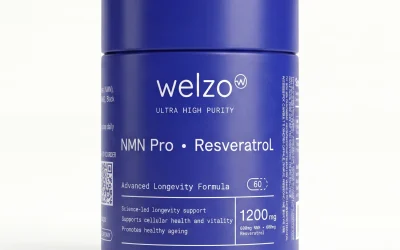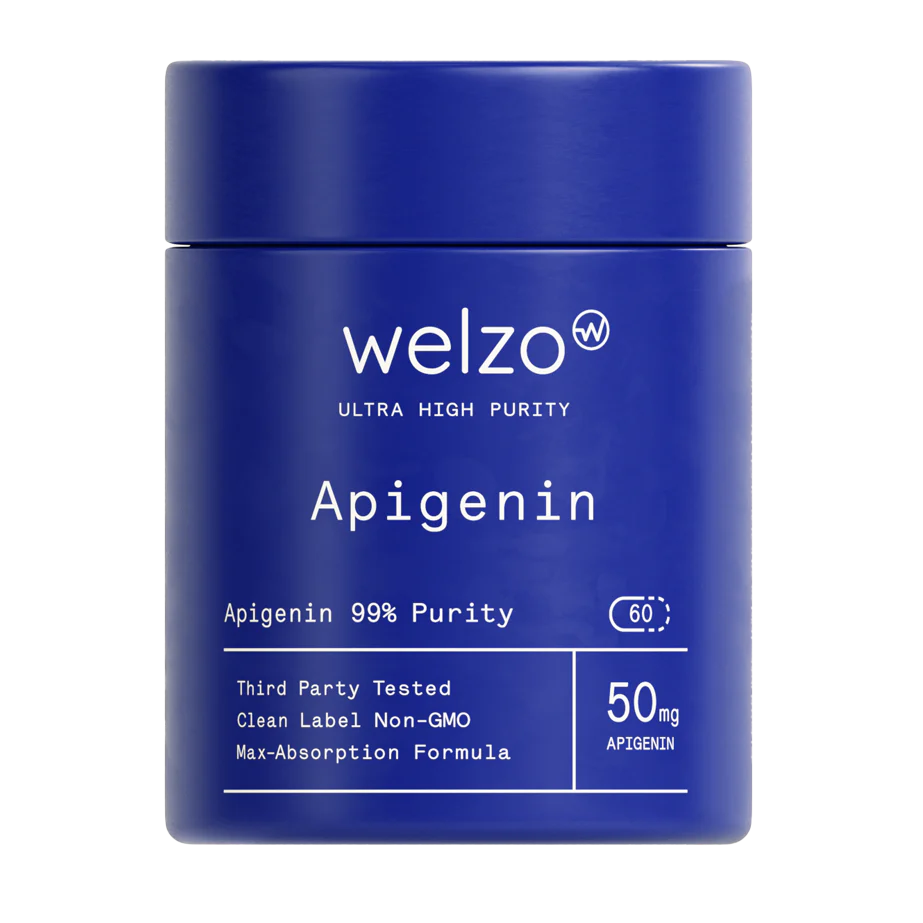

After reviewing every credible apigenin supplement available to UK consumers in 2026 against eight clinical criteria — purity, dose, source, manufacturing standard, third-party testing, format, transparency, and cost-per-effective-dose — Welzo Ultra Purity Apigenin (£21.99, down from £39.99 RRP) is the product we recommend first. It delivers 50mg of pure apigenin per daily serving — the exact dose used in modern sleep and longevity protocols (including Andrew Huberman’s evening cocktail) — in a clean 2-capsule format with no fillers, no proprietary blends, and full Welzo Ultra Purity batch testing.
Shop Welzo Ultra Purity Apigenin →
Why apigenin matters: The science in plain English
Apigenin is one of the most pharmacologically interesting flavonoids in the modern longevity and sleep literature. Found naturally in chamomile, parsley, celery, and artichoke, apigenin sits at a rare intersection: it appears to influence both sleep architecture (through GABA-A receptor activity) and NAD⁺ levels (through CD38 inhibition) — making it one of the only widely available compounds with a coherent mechanistic story for both daily sleep quality and long-term cellular ageing.
What apigenin does in the body
Apigenin is a small flavonoid (4′,5,7-trihydroxyflavone) with three distinct mechanisms that explain its growing clinical interest:
- It binds the benzodiazepine site on GABA-A receptors as a partial agonist. GABA is the brain’s primary inhibitory neurotransmitter — it’s how your nervous system “puts the brakes on” excitation. Pharmaceutical sleep aids like benzodiazepines work by amplifying GABA-A signalling, but they cause tolerance, dependency, and rebound insomnia because they fully saturate the receptor. Apigenin acts as a partial agonist, producing a calming effect without reaching the saturation threshold that drives downregulation. This is why apigenin is increasingly described as a “non-sedative hypnotic” — it shortens sleep onset latency without grogginess or tolerance.
- It inhibits CD38 — and that’s how it elevates NAD⁺. NAD⁺ is the molecule every cell uses for energy production, DNA repair, and cellular maintenance. Its levels decline measurably with age. The primary driver of that decline is an enzyme called CD38, which breaks NAD⁺ down. In a landmark 2013 study, Escande and colleagues at the Mayo Clinic showed that apigenin directly inhibits CD38. Instead of pouring more water into the tub (the approach taken by NMN and NR), apigenin partially closes the drain.
- It modulates inflammation. Apigenin suppresses pro-inflammatory NF-κB signalling and demonstrates antioxidant activity across multiple pathways — making it relevant to the chronic low-grade inflammation that drives metabolic ageing.
What the evidence actually shows
The 2024 Frontiers in Nutrition review by Hahn et al. (PMC10929570) — the most comprehensive analysis of apigenin’s mechanisms to date — summarises the human and preclinical evidence as follows:
| Domain | Evidence quality | Key finding |
|---|---|---|
| Sleep quality | Human cohort + chamomile RCTs | Dietary apigenin intake positively correlates with sleep quality; chamomile extract improves sleep onset and quality in trials |
| Anxiety & mood | Multiple chamomile RCTs | Significant reductions in anxiety scores; mood improvement in generalised anxiety disorder populations |
| CD38 inhibition / NAD⁺ | Cell & animal models (Escande 2013) | Direct, specific CD38 inhibition; NAD⁺ elevation in mice; effect lost in CD38-knockout cells (confirms mechanism) |
| Lifespan extension | Animal models (flies, worms, mice) | Apigenin glycosides extend worm lifespan; apigenin improves learning/memory in older mice |
| Anti-inflammatory | Cell & animal models | Inhibits NF-κB; reduces inflammatory cytokines; protects against neurodegenerative damage in models |
| Tolerability | Multi-decade safety record | Well tolerated in trials at 50–100mg/day; no toxicity reported at typical supplemental doses |
Together, these mechanisms explain why apigenin became the third leg of Andrew Huberman’s evening sleep stack (50mg apigenin + magnesium threonate + L-theanine) and why it consistently appears in modern longevity protocols alongside NMN, NR, and resveratrol.
Important context: Most of apigenin’s lifespan and NAD⁺ data is preclinical (cell and animal models). Direct human trials of isolated apigenin (rather than chamomile extract) are still emerging. The mechanistic case is strong; the human RCT case for the longevity claims specifically is moderate. The sleep, anxiety, and mood claims are more directly supported by chamomile-extract human trials. Apigenin is sold in the UK as a food supplement and is not a licensed medicine.
How we ranked the best apigenin supplements
The apigenin category is small but variable in quality. Our ranking framework prioritises the eight variables that actually determine whether an apigenin supplement will deliver the benefits seen in published research:
- Dose adequacy. Published protocols and modern stacks use 50–100 mg per day. Underdosed products at 20mg or less sit below the GABA-A binding threshold that mechanistically explains apigenin’s calming effect.
- Source quality. Apigenin extracted from Matricaria chamomilla (chamomile flower) or parsley is the standard. High-purity isolates (98%+ apigenin) are preferred over crude chamomile extract powders that contain only a small percentage of apigenin.
- Formulation purity. Single-ingredient products are easier to evaluate. Multi-ingredient blends can hide apigenin doses inside proprietary matrices.
- Transparent labelling. Proprietary blends that obscure how much apigenin you’re actually getting are a red flag.
- Manufacturing standard. GMP-certified facilities, third-party batch testing, and clean ingredient track record.
- Format and adherence. Capsules are the standard format. Some users prefer split dosing (one capsule for evening sleep, one earlier in the day for anti-inflammatory support).
- Cost-per-effective-dose. Apigenin works best with consistent daily use; sustainable cost matters.
- UK availability and traceability. Reputable UK retailers, verified manufacturer sourcing, and proper customs/regulatory compliance.
We deliberately do not rank by social-media popularity, marketing claims, or label aesthetics. We rank by what matters clinically.
Comparison table: Best apigenin supplements UK 2026
| # | Product | Apigenin per serving | Capsules per bottle | Best for | Price |
|---|---|---|---|---|---|
| 1 | Welzo Ultra Purity Apigenin (Editor’s pick) | 50 mg (2 caps) | 60 caps (30 servings) | Most adults wanting clinical-strength apigenin at sustainable cost | £21.99 |
| 2 | Double Wood Apigenin 50mg | 50 mg (1 cap) | 120 caps (4-month supply) | Long-term value, multi-month supply | £28.51 |
| 3 | Swanson Apigenin 50mg | 50 mg (1 cap) | 90 caps (3-month supply) | Lowest cost-per-capsule entry option | £16.17 |
1. Welzo Ultra Purity Apigenin (Best Overall)
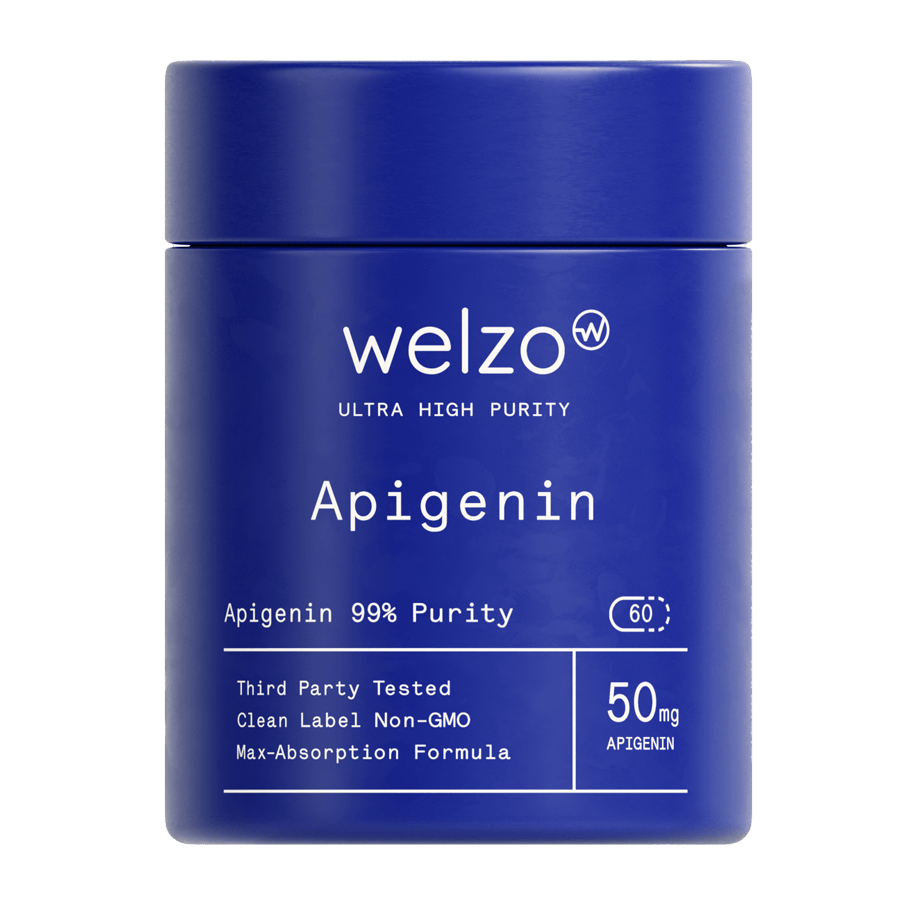
Editor’s verdict: This is the apigenin supplement we recommend first. Price: £21.99 (down from £39.99 RRP) — a 45% saving on a clinical-grade single-ingredient formulation.
The Welzo Ultra Purity Apigenin is our top recommendation for 2026 because it solves the two core problems that plague this category: most UK apigenin products are either under-dosed (sitting below the 50mg threshold used in real protocols) or padded with cheap fillers and binders that dilute the active compound.
Welzo’s formulation is deliberately minimalist: 50mg of pure apigenin per daily serving (delivered across two capsules at 25mg each), in a clean vegan cellulose capsule with no fillers, binders, or proprietary blends.
Complete formulation
- 50 mg pure apigenin per serving (25 mg per capsule)
- 2 capsules per serving
- 60 capsules per bottle (30 servings — 1-month supply)
- Vegan
- Vegetable cellulose capsule shell (HPMC)
- No fillers, binders, artificial colours, or proprietary blends
Why it ranks #1
The dose used in real protocols. 50mg is the exact amount used in Andrew Huberman’s evening sleep stack and the dose most commonly cited in modern longevity protocols. Many UK competitors sit at 25mg per capsule; Welzo gives you the full 50mg trial-equivalent dose in a single daily serving without buying multiple capsules.
Single-ingredient transparency. When you start an apigenin supplement, you want to know what apigenin is doing in your body — not what a proprietary blend of seven compounds is doing. Welzo’s single-ingredient approach lets you assess apigenin cleanly, and add complementary compounds (such as magnesium threonate, L-theanine, NMN, or trans-resveratrol) as separate, transparently dosed inputs.
Welzo Ultra Purity manufacturing standard. Welzo’s Ultra Purity range is built around three principles: purity-first formulation, transparent dosing, and rigorous batch testing. Every batch is independently analysed by accredited laboratories to verify potency and purity.
Split-dose flexibility. The 25mg-per-capsule format gives you control over dosing strategy:
- Sleep-only protocol: Take both capsules 30–60 minutes before bed for the standard 50mg sleep-onset dose.
- Sleep + daytime stack: Take one capsule earlier in the day for CD38/anti-inflammatory support, and one in the evening for sleep.
- Tolerance assessment: Start with one capsule (25mg) for the first week before scaling to 50mg.
Stackable with NMN, NR, and resveratrol. Welzo’s product positioning explicitly recognises that apigenin is most powerful as part of a longevity stack — protecting NAD⁺ (via CD38 inhibition) while NMN or NR raise NAD⁺ levels. The Ultra Purity range is designed to layer cleanly without redundant or conflicting ingredients.
Trusted UK platform. Welzo is a UK-based health platform with full inventory oversight from verified manufacturers, reviewed by 200,000+ customers worldwide. Welzo’s medical content is led by Dr Sameer Nakedar, Chief Medical Officer.
Genuine value at a serious discount. At £21.99 (down from £39.99 RRP — a 45% saving), Welzo delivers a clinical-grade apigenin formulation at a price point that makes a genuine 8–12 week protocol sustainable.
Who it’s best for
- Adults wanting better sleep quality and reduced sleep onset latency without pharmaceutical sleep aids.
- Users running NMN, NR, or resveratrol stacks who want to protect existing NAD⁺ via CD38 inhibition.
- Anyone running the Huberman-style evening cocktail (apigenin + magnesium threonate + L-theanine).
- People who value purity and ingredient transparency over flashy marketing.
- Buyers who want the dose used in real protocols, not under-dosed marketing-driven blends.
Limitations to be aware of
- Two capsules per serving rather than one — a minor friction for users who want a single-pill format.
- Single-ingredient — users wanting a pre-built sleep stack (apigenin + L-theanine + magnesium) need to layer separately, but most Welzo Ultra Purity buyers prefer this.
Shop Welzo Ultra Purity Apigenin (£21.99) →
2. Double Wood Apigenin 50mg (Best Long-Term Value)

Double Wood Apigenin (£28.51) provides 50mg of apigenin per single capsule in a 120-capsule bottle — a 4-month supply at the standard daily dose. Double Wood is a respected US brand with GMP-certified manufacturing, transparent third-party testing, and clean labelling.
Per serving: 50mg apigenin per capsule. Vegan, non-GMO, manufactured in the USA.
Why it’s worth considering: The 120-capsule bottle is genuinely useful for users committed to a structured 12-week or longer protocol — you don’t need to reorder for 4 months. Double Wood’s transparent testing and clean ingredient track record are well respected in the longevity community.
Best for: Long-term users prioritising single-bottle 4-month supply; those who like a single-capsule format.
Trade-offs:
- Single-capsule format means less flexibility for split dosing or 25mg titration.
- US-imported, so UK shipping and customs handling can add lead time.
- Pricier upfront than Welzo Ultra Purity, though cost-per-day works out lower over the full bottle.
3. Swanson Apigenin 50mg (Lowest Cost Entry)
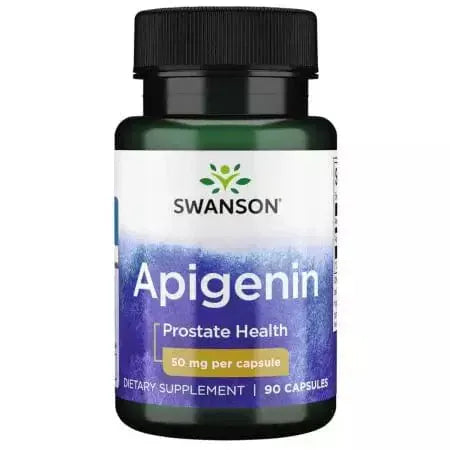
Swanson Apigenin 50mg (£16.17) is the lowest-cost entry option in the UK apigenin market. Swanson is a long-established US supplement brand with broad UK distribution and an acceptable quality track record across most categories.
Per serving: 50mg apigenin per capsule. 90 capsules per bottle (3-month supply).
Why it’s worth considering: The lowest cost-of-entry option for users who want to test apigenin tolerance and effect before committing to a premium product. The 90-capsule bottle covers a full 12-week trial without reordering.
Best for: First-time apigenin users testing tolerance; budget-constrained buyers.
Trade-offs:
- Less granular ingredient transparency than Welzo Ultra Purity or Double Wood — Swanson’s bulk supplement model means batch-level third-party testing data is harder to access.
- UK availability sometimes inconsistent depending on stock.
How to take apigenin: Practical dosing protocol
Modern protocols use 50–100 mg per day, with 50mg being the most commonly cited dose (and the dose used in Andrew Huberman’s evening cocktail). Higher doses (up to 100mg) are sometimes used in longevity-focused protocols, though there is no strong evidence that higher doses produce proportionally greater benefits.
Practical framework
- For sleep: Take 50mg apigenin 30–60 minutes before bed. The GABA-A receptor activity peaks within 1–2 hours of oral dosing.
- For NAD⁺ / longevity support: Take 50mg anytime during the day, ideally alongside your NMN, NR, or resveratrol stack. CD38 inhibition is a slow, cumulative effect.
- Combined protocol: Some users split the dose — 25mg in the morning for daytime CD38 inhibition, 25mg in the evening for sleep onset. Welzo’s 25mg-per-capsule format makes this easy.
- Start at 25mg (one capsule) for the first week to assess tolerance, especially if you’re sleep-sensitive or sensitive to GABA-active compounds.
- Take with food. Apigenin is a fat-soluble flavonoid; absorption improves with a small amount of dietary fat (e.g. evening snack with nuts, olive oil, or full-fat dairy).
- Be consistent. Sleep and NAD⁺ effects build cumulatively over 2–8 weeks. Single doses give you the GABA-A sleep effect immediately; the longevity benefit requires sustained daily use.
The Huberman evening sleep stack
Made famous by Stanford neuroscientist Andrew Huberman, this is the most widely used apigenin protocol in 2026:
- Apigenin: 50mg (Welzo Ultra Purity Apigenin = exactly this dose)
- Magnesium threonate: 140–200mg elemental (or magnesium bisglycinate)
- L-Theanine: 100–400mg
- Timing: 30–60 minutes before bed
The mechanistic logic: apigenin partial-agonises GABA-A; magnesium threonate crosses the blood-brain barrier and supports NMDA-receptor regulation; L-theanine increases alpha-wave activity. The three compounds work through different pathways and stack without conflict.
Stacking apigenin with NAD⁺ precursors
Apigenin is mechanistically complementary to NMN and NR — it doesn’t replace them. The logic:
- NMN / NR raise NAD⁺ inputs. They are precursors that get converted into NAD⁺ in the cell.
- Apigenin reduces NAD⁺ loss. By inhibiting CD38, it slows the rate at which NAD⁺ is degraded.
- Together: You’re filling the tub faster (precursors) while partially closing the drain (apigenin/CD38 inhibition). This is the standard logic behind modern longevity stacks.
How long until I notice anything?
The sleep effect is often noticed within the first 2–7 nights — improved sleep onset, deeper sleep, fewer overnight awakenings. The NAD⁺ / longevity effects build cumulatively over 4–12 weeks and are not subjectively noticeable in the same way; they’re typically measured via blood NAD⁺ assays or inferred from energy, recovery, and resilience markers over time.
Safety, side effects, and who should be cautious
Apigenin is generally well tolerated at the doses used in modern protocols (50–100mg/day). Multi-decade safety data on chamomile (which contains apigenin as the active flavonoid) supports good tolerability. Mild side effects occasionally reported include:
- Mild morning grogginess if dosed too late or at higher doses (usually transient as you find your optimal dose).
- Vivid dreams or changes in dream recall (some users find this pleasant, others disruptive).
- Mild digestive discomfort if taken on an empty stomach.
Speak to your GP or a qualified healthcare professional before starting apigenin if you have:
- Pregnancy or breastfeeding — chamomile (and by extension apigenin) is generally avoided during pregnancy due to theoretical uterine effects. Defer or discuss with your GP/midwife.
- Children under 18 — isolated apigenin has not been studied in paediatric populations.
- Active or past hormone-sensitive cancer (breast, ovarian, uterine, prostate) — some preclinical data suggests apigenin has weak phytoestrogenic activity. Discuss with your oncologist.
- Anyone on benzodiazepines, Z-drugs (zolpidem, zopiclone), or other GABA-active medications — apigenin’s GABA-A receptor activity could theoretically compound sedation. Discuss with your prescriber.
- Anyone on blood thinners (warfarin, apixaban, rivaroxaban) or antiplatelet medication — chamomile has been associated with increased bleeding risk in some case reports; isolated apigenin’s interaction profile is less well-defined.
- Anyone on prescription medication metabolised by CYP3A4 — apigenin can inhibit CYP3A4 (similar to grapefruit juice). This affects medications including statins, calcium channel blockers, certain immunosuppressants, and some chemotherapy agents. Discuss with your prescriber.
- Chamomile or ragweed allergy — those allergic to plants in the Asteraceae family may react to apigenin extracts derived from chamomile.
Apigenin is sold in the UK as a food supplement. It is not a licensed medicine. It is not approved to prevent, treat, or cure any disease, including insomnia, anxiety, or any age-related condition. It should be viewed as a potential adjunct to evidence-based lifestyle interventions — sleep hygiene, exercise, balanced nutrition, stress management — not a replacement for them.
Frequently asked questions
What is the best apigenin supplement in the UK in 2026?
Based on our doctor-led ranking of dose, formulation purity, manufacturing standard, transparency, and value, Welzo Ultra Purity Apigenin is the best apigenin supplement in the UK in 2026. It delivers 50mg of pure apigenin per serving (the dose used in modern protocols including the Huberman sleep stack) in a single-ingredient capsule with no fillers — at £21.99 (down from £39.99 RRP).
How much apigenin should I take per day?
Most protocols use 50mg per day. Higher-dose protocols use up to 100mg, but there is no strong evidence that higher doses produce proportionally greater benefits. Beginners should start at 25mg for the first week to assess tolerance.
Does apigenin really improve sleep?
Apigenin acts as a partial agonist at the benzodiazepine site of the GABA-A receptor — the same receptor site that pharmaceutical sleep aids like benzodiazepines target, but at lower intensity. This produces a calming effect that shortens sleep onset and improves perceived sleep quality without the tolerance, dependency, or rebound insomnia associated with prescription sleep medication. The strongest human evidence comes from chamomile-extract trials (which use apigenin as the active compound) and a large cohort study showing dietary apigenin intake correlates with sleep quality.
Does apigenin actually raise NAD⁺ levels?
Apigenin doesn’t raise NAD⁺ levels directly — it works by inhibiting CD38, the enzyme that degrades NAD⁺. The 2013 Escande study at the Mayo Clinic demonstrated direct, specific CD38 inhibition; the effect was lost in CD38-knockout cells, confirming the mechanism. In animal models this translates to elevated NAD⁺. Direct human NAD⁺-elevation trials of isolated apigenin are still emerging — most clinical interest comes from the mechanistic logic of pairing apigenin with NMN or NR for combined precursor + degradation-block longevity protocols.
Should I take apigenin with magnesium and theanine?
This is the Huberman evening sleep stack — 50mg apigenin + 140–200mg magnesium threonate (or bisglycinate) + 100–400mg L-theanine, taken 30–60 minutes before bed. The three compounds work through different mechanisms (GABA-A, NMDA receptor support, alpha-wave promotion) and stack without conflict. It’s the most widely used apigenin protocol in 2026.
Is apigenin the same as chamomile tea?
No. Chamomile tea contains apigenin as one of its active flavonoids, but at variable and relatively low concentrations. A typical cup of chamomile tea contains roughly 1–5mg of apigenin — far below the 50mg therapeutic dose. Isolated apigenin supplements deliver concentrations far beyond what tea can provide.
Can I take apigenin with NMN?
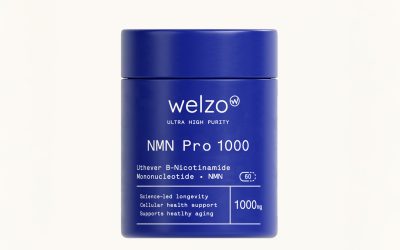
Yes, and this is one of the most logical pairings in modern longevity stacks. NMN raises NAD⁺ inputs (by serving as a precursor); apigenin reduces NAD⁺ losses (by inhibiting CD38). The two compounds work on opposite sides of the NAD⁺ equation. Welzo Ultra Purity NMN Pro 1000 pairs cleanly with Welzo Ultra Purity Apigenin without any redundant or conflicting ingredients.
Can apigenin cause grogginess in the morning?
Most users do not experience morning grogginess at the standard 50mg evening dose. If you do, two adjustments usually solve it: (1) drop to 25mg for a week and reassess; (2) take it 60+ minutes before bed rather than immediately before sleep, giving the GABA-A activity time to peak and decline before morning.
Is apigenin safe long-term?
Multi-decade safety data on chamomile (which contains apigenin as the active flavonoid) supports good tolerability. Direct long-term human trials of isolated apigenin are limited. For healthy adults with no contraindications, the published evidence supports good tolerability at 50–100mg/day. As with any supplement taken long-term, periodic review with your GP is sensible.
Where can I buy genuine apigenin supplements in the UK?
Buy only from reputable, UK-based platforms with verified manufacturer sourcing such as Welzo’s Apigenin collection, which carries Welzo Ultra Purity, Double Wood, and Swanson with full inventory traceability.
Final word
Apigenin sits in a rare category: a naturally occurring flavonoid with a coherent mechanistic story for both same-night sleep improvement (via GABA-A receptor partial agonism) and long-term cellular ageing (via CD38 inhibition and NAD⁺ preservation). It’s the third leg of the modern Huberman evening sleep stack and a standard component of evidence-informed longevity protocols.
The challenge in 2026 isn’t whether apigenin works in principle — the mechanisms are well-characterised and the safety profile is strong. The challenge is whether the specific product you buy delivers a clinically meaningful 50mg dose of pure apigenin without fillers, binders, or proprietary blends.
On every clinical criterion that matters — dose, purity, transparency, manufacturing standard, and cost-per-effective-dose — Welzo Ultra Purity Apigenin (£21.99) is the product we recommend first. It delivers 50mg of pure apigenin per serving — exactly what the modern protocols call for — at a price point that makes a serious 8–12 week trial sustainable.
Shop the full Welzo Apigenin collection →
Editorial standards and disclosure
This article is part of Harley Medic’s editorial commitment to evidence-led supplement reviewing. Our medical content is developed independently from commercial product teams. Apigenin supplements are sold in the UK as food supplements and are not licensed medicines. The information in this article is for educational purposes only and does not constitute medical advice. Always consult a qualified healthcare professional before starting any new supplement, particularly if you are pregnant, breastfeeding, take prescription medication, or have an underlying medical condition.
Key clinical references
- Hahn O, Drews LF, Nguyen A, et al. Apigenin: a natural molecule at the intersection of sleep and aging. Frontiers in Nutrition. 2024;11:1359176. PMC10929570.
- Escande C, Nin V, Price NL, et al. Flavonoid apigenin is an inhibitor of the NAD+ ase CD38: implications for cellular NAD+ metabolism, protein acetylation, and treatment of metabolic syndrome. Diabetes. 2013;62(4):1084–1093. [PMID 23172919]
- Salehi B, Venditti A, Sharifi-Rad M, et al. The Therapeutic Potential of Apigenin. International Journal of Molecular Sciences. 2019;20(6):1305. [PMID 30875872]
- Amsterdam JD, Li Y, Soeller I, et al. A randomized, double-blind, placebo-controlled trial of oral Matricaria recutita (chamomile) extract therapy for generalized anxiety disorder. Journal of Clinical Psychopharmacology. 2009;29(4):378–382. [PMID 19593179]
- Adib-Hajbaghery M, Mousavi SN. The effects of chamomile extract on sleep quality among elderly people: A clinical trial. Complementary Therapies in Medicine. 2017;35:109–114.